Hospital ETO Sterilizer

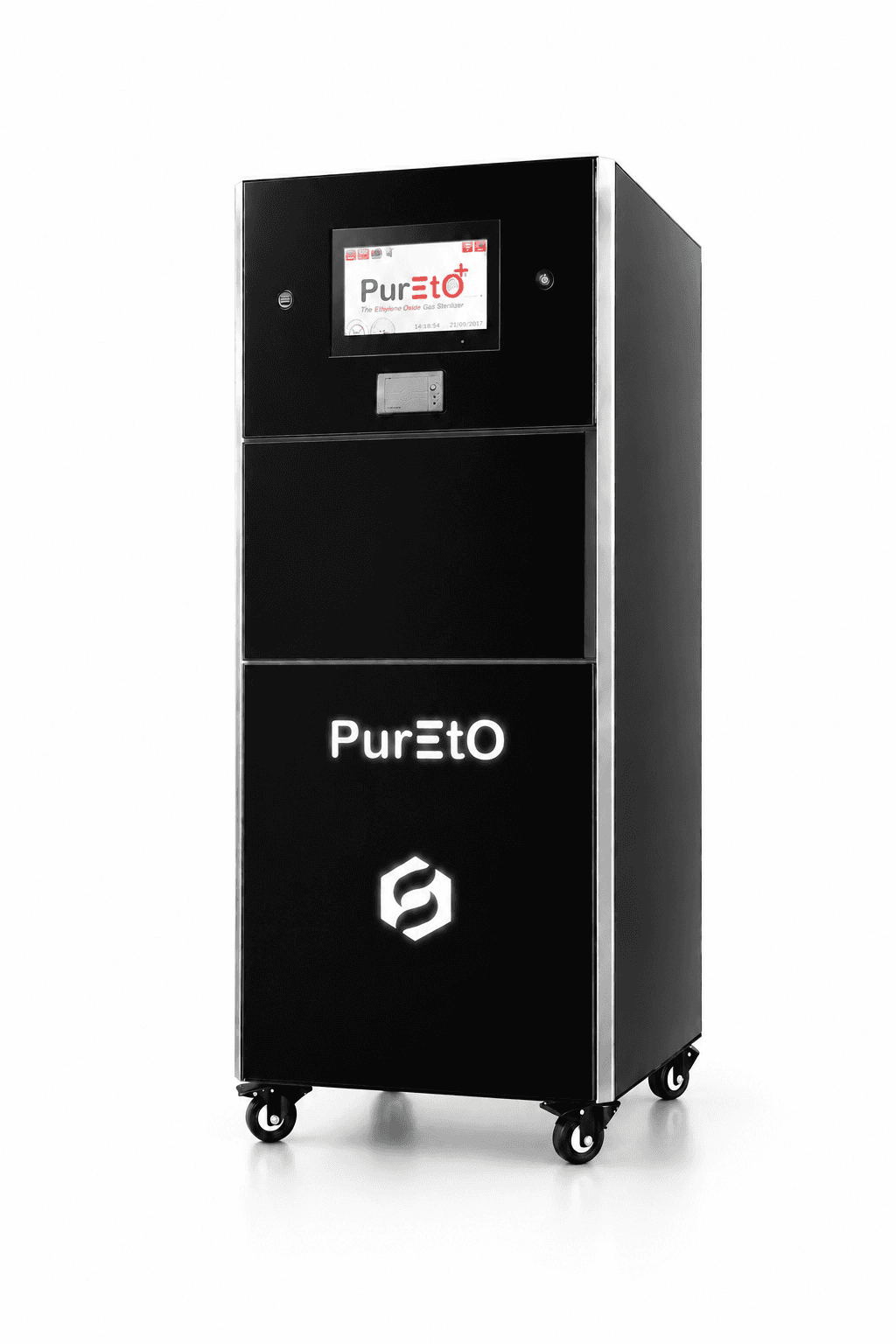
PurETO+ Hospital ETO Sterilizer for CSSD and Medical Device Workflows
A hospital-scale EO gas sterilizer for controlled low-temperature processing of heat- and moisture-sensitive medical devices.
Sterilizer Overview
EO gas sterilization for validated low-temperature loads
PurETO+ is SSQ's hospital-scale ethylene oxide (ETO) sterilizer for CSSD departments, larger healthcare facilities, laboratories, pharmaceutical companies, and medical device manufacturers that need controlled, low-temperature EO gas sterilization of heat- and moisture-sensitive medical devices.
Ethylene oxide gas penetrates complex geometries, lumens, and packaging, which is why EO sterilization is widely used for instruments and devices made from plastics, polymers, electronics, tubing, and catheters that cannot tolerate high-temperature steam sterilization. PurETO+ supports warm and cold EO cycle configurations for compatible packaged and unpackaged loads.
Each cycle runs through controlled conditioning, EO exposure, evacuation, and aeration phases, with operator controls and cycle reporting options available based on model configuration to support traceable, repeatable medical device sterilization.
Who is it for?
Hospitals, CSSD departments, laboratories, pharmaceutical companies, and medical device manufacturers with higher-volume EO gas sterilization requirements.
What problem does it solve?
High-volume facilities need a low-temperature sterilization method for heat-sensitive devices while keeping cycles traceable and operator workflows predictable.
Sterilization technology
PurETO+ uses ethylene oxide (EO) gas to sterilize compatible medical devices at low temperature. Ethylene oxide acts as an alkylating agent on microorganisms, and because it works as a gas it can reach surfaces, lumens, and the inside of permeable packaging.
Each PurETO+ cycle moves through conditioning, ethylene oxide exposure, evacuation, and aeration. Conditioning brings the load to the programmed temperature and humidity, EO exposure holds a controlled gas concentration for the validated dwell time, and evacuation followed by aeration removes residual gas before the load is released.
Because the process runs at low temperature and low moisture compared with steam sterilization, it is widely used for heat- and moisture-sensitive medical devices that would be damaged by high-temperature steam autoclaving.
Key features
Low-temperature EO gas sterilization
Designed for heat- and moisture-sensitive medical devices that are unsuitable for steam.
Touch-screen operation
A clear operator interface for cycle selection, status, alarms, and guided operation.
Programmable warm and cold cycles
Cycle profiles can be configured for different load types and facility workflows.
Software-controlled door locking
Door release is controlled through the system when operating conditions are safe.
Cycle records
Integrated print and digital record options are available based on model configuration.
Scalable chamber options
Model options support a range of hospital and medical device processing volumes.
Process advantages
Deep gas penetration
Ethylene oxide gas can reach complex geometries, lumens, and the inside of permeable packaging for compatible loads.
Low-temperature processing
Runs well below steam sterilization temperatures, helping protect heat-sensitive materials and electronics.
Broad material compatibility
Suitable for many plastics, polymers, elastomers, and metal instruments, subject to validation.
Packaged-load sterilization
Compatible devices can be sterilized inside permeable final packaging for many applications.
Repeatable, controlled cycles
Programmable parameters support consistent, validated processing across loads.
Traceable records
Print and digital cycle records are available based on configuration to support documentation.
Cycle process overview
- 01
Load and seal - arrange packed instruments for gas penetration and close the chamber.
- 02
Conditioning - bring humidity and temperature to the programmed cycle setpoint.
- 03
EO exposure - hold a controlled ethylene oxide dose for the configured dwell time.
- 04
Evacuation - remove EO gas from the chamber through controlled evacuation and flushing.
- 05
Aeration - purge residual gas before the load is released for handling.
Safety and operation
- Door and pressure interlocks designed to support controlled operation.
- Controlled evacuation and aeration phases to support EO gas handling.
- Status indicators, alarms, and cycle records for operator awareness.
Technical snapshot
- Method
- Ethylene oxide gas sterilization
- Model range
- 50L, 80L, 100L, 135L, 240L options
- Cycle options
- Warm and cold cycle configurations
- Records
- Printer / digital reports based on configuration
Validation and documentation support
Effective EO sterilization depends on a validated process for each load type. SSQ can support discussions around cycle parameters, load configuration, and documentation so the PurETO+ installation fits the facility's quality requirements.
Product documentation and cycle record options are available based on model configuration. Sterilization validation, routine monitoring, and load-release decisions remain the responsibility of the facility's quality and biomedical teams, following applicable standards and guidance.
Applications
Where PurETO+ fits
PurETO+ is intended for facilities evaluating ethylene oxide sterilization where compatible loads require a controlled low-temperature EO gas process.
Hospital CSSD departments
For centralized EO gas sterilization workflows with larger chamber and throughput requirements.
Medical device manufacturers
For compatible packaged devices and production loads that require low-temperature EO processing.
Laboratories and research centers
For controlled EO sterilization of compatible research, testing, and laboratory items.
Heat- and moisture-sensitive devices
For compatible materials that may not tolerate high-temperature steam sterilization.
Suitable instruments and devices
- ✓Plastic and polymer instruments
- ✓Catheters and tubing
- ✓Devices with electronics or sensors
- ✓Compatible endoscopic and minimally invasive instruments
- ✓Rubber and elastomer components
- ✓Packaged single-use and reusable devices
- ✓Complex instruments with lumens
- ✓Heat- and moisture-sensitive surgical devices
Instrument and device compatibility depends on materials, design, packaging, and the validated cycle. SSQ can help review the application before recommending a configuration.
Industries served
Frequently asked questions
PurETO+ is an advanced ethylene oxide sterilizer for low-temperature EO gas processing of compatible heat- and moisture-sensitive medical devices in hospitals, CSSD departments, laboratories, and device manufacturing environments.
An EO sterilizer, or ethylene oxide sterilizer, uses ethylene oxide gas to sterilize heat- and moisture-sensitive medical devices at low temperature. It is widely used where high-temperature steam sterilization is not suitable.
ETO sterilizer is another common name for an EO sterilizer. 'ETO' and 'EO' both refer to ethylene oxide gas sterilization, so an ETO sterilizer and an EO sterilizer are the same type of low-temperature system.
Ethylene oxide sterilizes at low temperature and penetrates complex devices, lumens, and packaging, which makes it suitable for plastics, polymers, electronics, and tubing that high-temperature steam can damage.
EO sterilization is commonly used for compatible heat- and moisture-sensitive devices such as catheters, tubing, plastic and polymer instruments, and packaged medical devices. Material and packaging compatibility should be confirmed for each validated load.
Yes. Because EO sterilization operates at low temperature, it is often selected for heat- and moisture-sensitive instruments and devices that cannot tolerate steam sterilization, subject to validated compatibility.
Steam sterilization uses high-temperature pressurized steam, while EO sterilization uses ethylene oxide gas at low temperature. EO is chosen for devices that would be damaged by the heat or moisture of steam.
Aeration removes residual ethylene oxide from the load after the cycle so devices can be handled safely. PurETO+ includes a controlled aeration phase as part of the EO process.
Yes. Ethylene oxide gas can penetrate many packaging materials, so EO sterilization is widely used for compatible packaged medical devices, subject to validation of the package and load.
PurETO+ is suited to larger hospitals, CSSD departments, and medical device manufacturers that need higher-volume EO gas sterilization workflows.
PurETO+ is the hospital-scale platform for larger chamber and throughput needs. PurETO Elica is the compact table-top ETO sterilizer range for lower-volume or space-conscious facilities.
Cycle record options such as printing and digital reporting are available based on model configuration. SSQ can help match the documentation requirement to the selected model.
Related products
ETO Sterilizer
PurETO Elica
A compact table top EO gas sterilizer for low-temperature processing where space, usability, and repeatable cycle control matter.
H2O2 Plasma Sterilizer
EiligPlaz
A low-temperature H2O2 plasma sterilizer for compatible laparoscopic, ophthalmic, and delicate surgical instruments.
H2O2 Plasma Sterilizer
HyperPlaz
A 30 litre compact H2O2 plasma sterilizer for compatible heat-sensitive surgical instruments and space-conscious facilities.
Need help evaluating PurETO+?
Share your facility type, load profile, chamber requirement, cycle needs, and documentation expectations. SSQ can help confirm whether this model or another platform is the right fit.